|
|
Joined: Dec 1999
Posts: 30,867
Master Elite Member
|
 |
Tell Congress to Stop
EPA's Implementation of the UN's Agenda
21
 One of the most successful grassroots
campaigns during the past year has been the Stop Agenda 21 movement both at the local level and state level. However, we haven't heard as
much about Agenda 21 implementation at the national
level. Of course, there were President Bill Clinton's
establishment of the
President's Council on Sustainable
Development by executive order in 1993 and President
Obama's " Federal Leadership in Environmental, Energy, and
Economic Performance" executive order in 2009. And, many
federal agencies have been incorporating sustainability into
various aspects of their organizations. Still, virtually all
Stop Agenda 21 grassroots activity has been focused on the
local and state levels. The establishment of Clinton's
President's Council on Sustainable Development (PCSD) started
a pattern of denial by federal government agencies regarding
any connection with the UN's Agenda 21. Even though the PCSD
was clearly established in 1993 in support of the UN's Agenda
21 and its Sustainable Development proposals from the UN's '92
Earth Summit in Rio, the PCSD's statements and documents never
referred to the UN and Agenda 21. We have evidence that
federal officials were taking pains to make the PCSD appear to
be completely separate from the UN's Agenda 21 because J. Gary Lawrence, an advisor to the PCSD, said
the following in 1998: "Participating in a UN
advocated planning process would very likely bring out many of
the conspiracy-fixated groups and individuals in our
society.... This segment of our society who fear ‘one-world
government’ and a UN invasion of the United States through
which our individual freedom would be stripped away would
actively work to defeat any elected official who joined ‘the
conspiracy’ by undertaking LA21 [Local Agenda 21]. So, we call
our processes something else, such as comprehensive planning,
growth management or smart growth." This helps explain
why virtually all federal activities in pursuit of
sustainability rarely make any reference to the UN or the UN's
Agenda 21, even though these federal activities are very much
in sync with the UN's Agenda 21. Nonetheless, there
have been very significant developments regarding
sustainability at the Environmental Protection Agency (EPA)
beginning with its 40th anniversary in late 2010. On November
30, 2010, EPA Administrator Lisa Jackson stated:
"Today I am formally requesting President Cicerone and the
National Academies convene a committee of experts to provide
to the U.S. EPA an operational framework for sustainability
that applies across all of the agency’s programs, policies,
and actions." Jackson added: "Today we have a new
opportunity in front of us. We have an opportunity to focus on
how environmentally protective and sustainable we can be. You
see, it’s the difference between treating disease and pursuing
wellness." 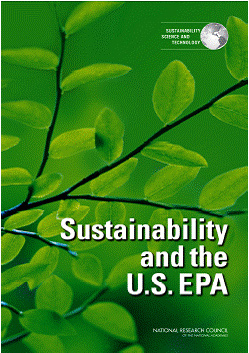 The National Academies of
Science (NAS) responded with a detailed study, Sustainability and the U.S. EPA
(aka the "Green Book"), which cost the EPA $700,000, and which
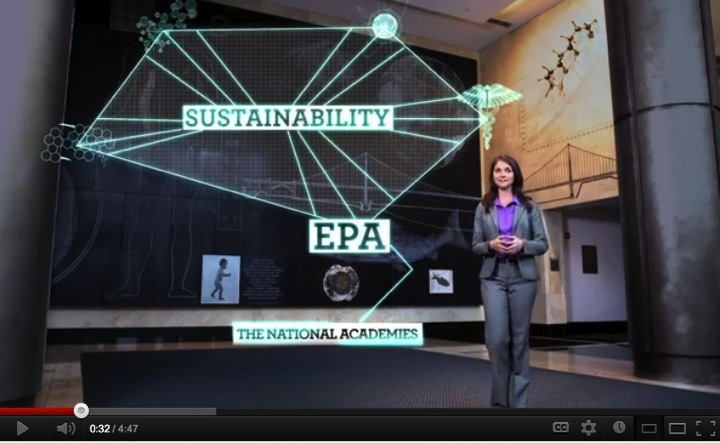
was published in August 2011. The NAS also produced a 5-minute video (see graphic above) about
this project. Here are some excerpts from the 286-page
"Green Book":
- "The [UN’s World Commission on Environment and
Development] called upon the UN General Assembly to
transform its [1987] report into a global action plan for
sustainable development. The nations of the world did
precisely that at the 1992 UN Conference on Environment and
Development, or “Earth Summit,” in Rio de Janeiro. These
nations, including the United States, endorsed a global
sustainable development action plan, known as Agenda 21, and
a set of 27 principles for sustainable-development, called
the Rio Declaration. Together, these agreements modify the
definition of development by adding a third pillar --
environmental protection and restoration -- to the economic
and social pillars of development...."
- "First, the committee recommends that EPA formally adopt
as its sustainability paradigm the 'Three Pillars' approach
of 'Social,' 'Environment,' and 'Economic' dimensions of
sustainability….”
- "Sustainability impact assessment is used to analyze the
probable effects of a particular project or proposal on the
social, environmental, and economic pillars of
sustainability.”
Thus, the "Green Book"
acknowledges that the nations of the world, including the
United States, "endorsed a global sustainable development
action plan, known as Agenda 21" at the '92 Earth Summit in Rio.
Next, the NAS committee recommended that "EPA formally adopt
as its sustainability paradigm the 'Three Pillars' approach of
'Social,' 'Environment,' and 'Economic' dimensions of
sustainability….” Which would make the EPA sustainability
paradigm exactly in sync with the three pillars of sustainable
development agreed upon at the '92 Earth Summit. Finally, the
NAS proposed a new tool for EPA, the sustainability impact
assessment, that would be "used to analyze the probable
effects of a particular project or proposal on the social,
environmental, and economic pillars of
sustainability.” Therefore, it is apparent that the NAS
"Green Book" is positioning the EPA to become the premier
federal agency for implementing Agenda 21 in the United
States.
EPA spokesman are wary in this
highly-charged, election-year political climate about making
any definitive statement regarding whether and how soon
the EPA would adopt the "Green Book" sustainability
methodology. However, it is clear from listening to the audio of the November 30, 2010, meeting
where the EPA commissioned the NAS to produce a new
"operational framework for sustainability" for the EPA that
the EPA sees the "sustainability paradigm" as the future for
the agency. Moreover, just to keep it real for those
of us accustomed to the American way of life, here is what
Maurice Strong, Secretary-General of the UN Earth Summit in
Rio in 1992, said in his opening speech to the attendees:
“Current lifestyles and consumption patterns of the affluent
middle class -- involving high meat intake, the use of fossil
fuels, electrical appliances, home and work-place
air-conditioning, and suburban housing -- are not
sustainable.” (emphasis added) Based on
Strong's remarks, it doesn't take much of an imagination to
predict just how much downward pressure on our standard of
living would be exerted by a sustainability oriented EPA.
It also doesn't take too much talent at connecting the
dots to understand that an EPA based on sustainability, an EPA
that wants to pursue wellness, not treat disease, an EPA that
wants to use "sustainability impact assessments" to analyze
the probable effects of a particular project or proposal on
the social, environmental, and economic dimensions of
sustainability -- that would be an EPA that would aspire to
regulate in detail virtually every aspect of our lives, thus
completely destroying our freedom and prosperity. The
point of all of the above is that even though the EPA is
already guilty of vastly overregulating us, an EPA based on an
operational framework of sustainability would be much
worse. There's no legislation in Congress to stop the
EPA from implementing the UN Agenda 21 concept of
sustainability, but that doesn't mean that we shouldn't start
alerting Congress to the impending problem. Realistically,
given the makeup of Congress, there's virtually no hope of
getting a bill passed this year to stop EPA implementation of
Agenda 21 sustainability. Nonetheless, on the plus
side, the Stop Agenda 21 movement has been gaining momentum
over the past year, especially at the local and state level,
and Congress could very well be more receptive to anti-Agenda
21 legislation in 2013. So let's start contacting our
Representative and Senators now and urge them to
acquaint themselves with the EPA's preparations to implement
the UN's Agenda 21 and why that would be disastrous for our
freedom and prosperity. Then, ask them to take the appropriate
legislative action to prevent the EPA from implementing the
UN's Agenda 21 Sustainability paradigm. In short, we
need to start the educational process now to provide a better
chance of success in the next
Congress. Thanks.
Your Friends at The John Birch
Society
| | |
|
|
|
|
|


