|
|
Joined: Dec 1999
Posts: 30,867
Master Elite Member
|

Support National
Right-to-Work Act
Many Americans are very thankful
to have a job in these critical economic times -- a job that puts food on
the table, keeps the house warm in winter, puts gas in the car to get to
work, and leaves a little left over to purchase some geraniums to plant
along the front porch. But many Americans lose these jobs or face a
stressful work environment that includes discrimination and persecution
because they don’t want to be coerced into joining a union and paying
union dues -- dues that end up being used by union bosses for political
spending and advocacy. It's hard to believe that in the United States laws
have been passed that actually prohibit people from being able to choose
whether they want to participate in something they often don’t support or
believe in, as a condition of employment.
Then of course, there
are businesses that suffer monetary setbacks and losses because of the
cost of implementing union rules and that see the workplace turned into a
battleground for union expansion through strong-arm tactics and
intimidation. Some unions have become so powerful that their style of
union promotion and rules enforcement mimics Mafia protection rackets.
In order to reverse these unfair practices and hindrances for
employers and employees, there is a newly introduced bill in the U.S.
Senate, S. 2173, that would right the wrongs of forced union
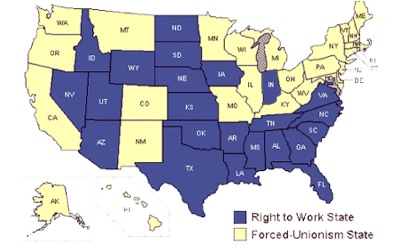
membership and closed shops. The National Right-to-Work Act would legally
protect the free choice of individuals to join, or not join, labor
organizations.
“Forced-unionism allows union bosses to forcibly
take dues from a politically diverse group of workers and then give
hundreds of millions every year almost exclusively to one political party.
Workers should have the right to provide for their families without having
to pay for political activity they strongly disagree with,” said Sen. Jim
DeMint, (R-SC), the Senator who introduced this bill.
Rank and file
union members themselves oppose their union bosses political spending,
viewing it as wasteful, an October 2010 poll indicated. In fact, 59 percent of
union members would vote to replace their own union leadership if given a
secret ballot election, over 50 percent view ObamaCare as a failure, 80
percent support the Right-to-Work principle, while a whopping 90 percent
favor more union disclosure and accountability.
A Winter 2010 Cato Journal analysis of right-to-work laws by
Richard Vedder from Ohio University shows that in states unencumbered by
heavy-handed union rules and intimidation, worker well-being outperforms
forced-union states. An article posted on The Hill states: “From 2000 to 2008, about
4.7 million Americans moved from forced-union to right-to-work states and
a recent study found that there is ‘a very strong and highly statistically
significant relationship between right-to-work laws and economic growth,’
and that from 1977 to 2007, right-to-work states experienced a 23 percent
faster growth in per capita income than states with forced
unionization.”
And, “Contrary to much union rhetoric, right-to-work
laws don't ban or bust unions. They simply grant individual workers the
right to join or not to join, even once a workplace is organized by a
union,” declares a Wall Street Journal February 2010 article.
Help workers keep more of what they earn, protect the workplace
environment from monopolistic labor union tactics, end the stifling of
competition by keeping industries at home in America, and stop the further
erosion of employment liberty by restoring complete freedom for workers
and employers with S. 2173, the National Right-to-Work Act.
This proposed legislation has already been placed on the
Senate calendar, so contact your Senators and Representative and ask
them to promote and pass this bill that would positively
affect millions of hard-working, tax-paying Americans, and that would
decrease the stranglehold activist and political-agenda-driven union
bosses currently have on employers and
employees.
Thanks.
Your friends at The John Birch
Society |
|
|
|
|
|