|
|
Joined: Dec 2007
Posts: 449
Advanced Master Member
|
False claims again CTD - you really need to learn some facts. And you waste your time. RAZD already said the DNA-based fantasy must match the fossil-based fantasy. They don't match.
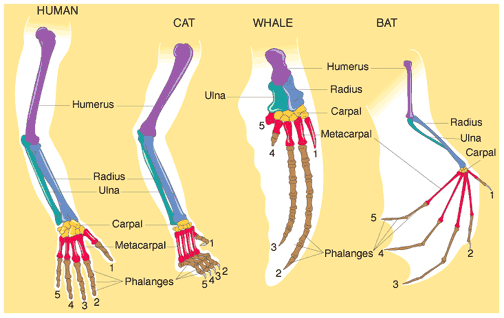
But that is, yet again, where you are wrong. Morphology studies give us a tree of relationships between the various organisms and, guess what, so does DNA and even more importantly they give virtually identical trees. Both methods independently show the same relationships between organisms. Not whales. I wonder how that could have happened. I wonder why whales don't count. (Not really. We all know.) But I do wonder why you think you can convince anyone whales don't count. (Well, not really again. You have demonstrated how stupid you think people are.) Homologues structures are anatomical features that are structurally similar but functionally different. The diagram below shows examples of homologues structures. Evolutionary theory predicts that the structures of organisms will show greater overall anatomical similarity based on relatedness rather than function. Notice that the bat wing is more similar anatomically to other mammals than it is to bird wings, even though bird wings and bat wings perform more similar functions than, for example, a cat paw and a bat wing. This indicates that bats are related to cats more closely than they are to birds, i.e. that bats and cats have a more recent common ancestor than bats and birds. Fish, whales, and penguins also provide an excellent example. The appendages of fish, whales, and penguins all serve the same basic function - underwater propulsion and guidance. Evolutionary theory predicts that the overall anatomical structure of whale fins will be more similar to the structure of other mammal forelimbs than it will be to the structure of penguin wings or fish fins. The same goes for the others. Evolutionary theory predicts that the structure of penguin wings will be more similar to the structure of bird wings than to the structure of fish fins or whale fins, etc. This prediction has been tested thousands of times, and in no case has an exception to it ever occurred. This condition is exactly what evolutionary theory predicts.(bold for emphasis) So once again reality contradicts a CTD assertion, proving his assertion to be false. We can also discuss the evolution of whales from Pakicetus that shows how these different functions from same parts evolved: http://www-personal.umich.edu/~gingeric/PDGwhales/Whales.htm Figure 1. Skeletons of the archaeocetes Dorudon atrox and Rodhocetus balochistanensis compared to that of Elomeryx armatus, which is here taken as a model for the extinct group of artiodactyls (Anthracotheriidae, s.l.) that we now think may have given rise to archaic whales. Pakicetus has a distinctive skull and lower jaw, but is not demonstrably different from early protocetids postcranially. Note changes in body proportions and elongation of feet for foot-powered swimming in Rodhocetus, then later reduction of the hind limbs and feet as the tail-powered swimming of modern cetaceans evolved in Dorudon.(bold in original) Rodhocetus balochistanensis and Elomeryx armatus are the newly added transitional fossils in the long line of transitional fossils for this post. Enjoy
Last edited by RAZD; 09/26/08 08:01 AM.
|
|
|
|
Entire Thread
|

 Transitions, telling truth from lies |
RAZD
|
09/14/08 05:03 PM
|
|
Re: Transitions, telling truth from lies
|
Jeanie
|
09/14/08 09:10 PM
|
|
Re: Transitions, telling truth from lies
|
Mordred
|
09/14/08 09:53 PM
|
|
Re: Transitions, telling truth from lies
|
Jeanie
|
09/14/08 10:08 PM
|
|
Re: Transitions, telling truth from lies
|
RAZD
|
09/14/08 10:24 PM
|
|
Re: Transitions, telling truth from lies
|
Jeanie
|
09/14/08 10:42 PM
|
|
Re: Transitions, telling truth from lies
|
RAZD
|
09/15/08 12:15 AM
|
|
Re: Transitions, telling truth from lies
|
Jeanie
|
09/15/08 01:29 AM
|
|
Re: Transitions, telling truth from lies
|
Kitsune
|
09/15/08 06:23 AM
|
|
Re: Transitions, telling truth from lies
|
Jeanie
|
09/15/08 09:13 PM
|
|
Re: Transitions, telling truth from lies
|
Russell2
|
09/15/08 11:00 PM
|
|
Re: Transitions, telling truth from lies
|
Mordred
|
09/16/08 08:05 AM
|
|
Re: Transitions, telling truth from lies
|
CTD
|
09/16/08 05:58 AM
|
|
Re: Transitions, telling truth from lies
|
Bex
|
09/16/08 06:16 AM
|
|
Re: Transitions, telling truth from lies
|
CTD
|
09/16/08 06:46 AM
|
|
Re: Transitions, telling truth from lies
|
Kitsune
|
09/16/08 07:21 AM
|
|
Re: Transitions, telling truth from lies
|
RAZD
|
09/16/08 11:50 AM
|
|
Re: Transitions, telling truth from lies
|
CTD
|
09/17/08 06:12 PM
|
|
Re: Transitions, telling truth from lies
|
Kitsune
|
09/18/08 05:49 AM
|
|
Re: Transitions, telling truth from lies
|
CTD
|
09/18/08 06:00 AM
|
|
Re: Transitions, telling truth from lies
|
Kitsune
|
09/18/08 06:07 AM
|
|
Re: Transitions, telling truth from lies
|
CTD
|
09/18/08 06:53 AM
|
|
Re: Transitions, telling truth from lies
|
RAZD
|
09/18/08 12:03 PM
|
|
Re: Transitions, telling truth from lies
|
CTD
|
09/18/08 06:00 PM
|
|
Re: Transitions, telling truth from lies
|
Russ
|
09/18/08 08:51 PM
|
|
Re: Transitions, telling truth from lies
|
LinearAq
|
09/19/08 02:08 PM
|
|
Re: Transitions, telling truth from lies
|
CTD
|
09/19/08 03:06 PM
|
|
Re: Transitions, telling truth from lies
|
LinearAq
|
09/19/08 04:17 PM
|
|
Re: Transitions, telling truth from lies
|
RAZD
|
09/21/08 12:30 AM
|
|
Re: Transitions, telling truth from lies
|
CTD
|
09/21/08 09:34 AM
|
|
Re: Transitions, telling truth from lies
|
RAZD
|
09/21/08 04:01 PM
|
|
Re: Transitions, telling truth from lies
|
Bex
|
09/21/08 09:37 PM
|
|
Re: Transitions, telling truth from lies
|
RAZD
|
09/22/08 01:23 AM
|
|
Re: Transitions, telling truth from lies
|
Bex
|
09/22/08 07:13 AM
|
|
Re: Transitions, telling truth from lies
|
Russ
|
09/22/08 07:11 PM
|
|
Re: Transitions, telling truth from lies
|
CTD
|
09/22/08 07:40 PM
|
|
Re: Transitions, telling truth from lies
|
Bex
|
09/23/08 01:10 AM
|
|
Re: Transitions, telling truth from lies
|
Russell2
|
09/23/08 01:16 AM
|
|
Re: Transitions, telling truth from lies
|
RAZD
|
09/23/08 01:35 AM
|
|
Re: Transitions, telling truth from lies
|
CTD
|
09/23/08 07:07 AM
|
|
Re: Transitions, telling truth from lies
|
Kitsune
|
09/23/08 07:52 AM
|
|
Re: Transitions, telling truth from lies
|
CTD
|
09/23/08 09:07 AM
|
|
Re: Transitions, telling truth from lies
|
Kitsune
|
09/23/08 01:29 PM
|
|
Re: Transitions, telling truth from lies
|
CTD
|
09/23/08 08:22 PM
|
|
Re: Transitions, telling truth from lies
|
Kitsune
|
09/23/08 09:11 PM
|
|
Re: Transitions, telling truth from lies
|
CTD
|
09/23/08 09:46 PM
|
|
Re: Transitions, telling truth from lies
|
CTD
|
09/23/08 09:56 PM
|
|
Re: Transitions, telling truth from lies
|
Bex
|
09/23/08 09:28 PM
|
|
Re: Transitions, telling truth from lies
|
Russell2
|
09/24/08 12:01 AM
|
|
Re: Transitions, telling truth from lies
|
RAZD
|
09/24/08 01:04 AM
|
|
Re: Transitions, telling truth from lies
|
Russell2
|
09/24/08 01:22 AM
|
|
Re: Transitions, telling truth from lies
|
Russell2
|
09/24/08 01:47 AM
|
|
Re: Transitions, telling truth from lies
|
Bex
|
09/24/08 12:43 PM
|
|
Re: Transitions, telling truth from lies
|
Russell2
|
09/24/08 11:58 PM
|
|
Re: Transitions, telling truth from lies
|
CTD
|
09/25/08 12:08 AM
|
|
Re: Transitions, telling truth from lies
|
Russell2
|
09/25/08 09:39 PM
|
|
Re: Transitions, telling truth from lies
|
RAZD
|
09/25/08 03:35 AM
|
|
Re: Transitions, telling truth from lies
|
CTD
|
09/25/08 10:53 AM
|
|
Re: Transitions, telling truth from lies
|
RAZD
|
09/26/08 12:32 AM
|
|
Re: Transitions, telling truth from lies
|
CTD
|
09/26/08 09:03 AM
|
|
Re: Transitions, telling truth from lies
|
RAZD
|
10/03/08 01:42 AM
|
|
Re: Transitions, telling truth from lies
|
CTD
|
10/03/08 04:30 PM
|
|
Re: Transitions, telling truth from lies
|
Kitsune
|
10/03/08 06:10 PM
|
|
Re: Transitions, telling truth from lies
|
Bex
|
10/03/08 07:30 PM
|
|
Re: Transitions, telling truth from lies
|
Bex
|
10/03/08 06:20 PM
|
|
Re: Transitions, telling truth from lies
|
Kitsune
|
10/03/08 08:17 PM
|
|
Re: Transitions, telling truth from lies
|
Bex
|
10/04/08 03:58 AM
|
|
Re: Transitions, telling truth from lies
|
Kitsune
|
10/04/08 07:00 AM
|
|
Re: Transitions, telling truth from lies
|
RAZD
|
10/04/08 03:42 PM
|
|
Re: Transitions, telling truth from lies
|
Kitsune
|
10/04/08 04:17 PM
|
|
Re: Transitions, telling truth from lies
|
Pwcca
|
10/04/08 05:20 PM
|
|
Re: Transitions, telling truth from lies
|
Jeanie
|
10/04/08 11:56 PM
|
|
Re: Transitions, telling truth from lies
|
Bex
|
10/05/08 12:36 AM
|
|
Re: Transitions, telling truth from lies
|
Jeanie
|
10/05/08 02:30 AM
|
|
Re: Transitions, telling truth from lies
|
Bex
|
10/05/08 02:32 AM
|
|
Re: Transitions, telling truth from lies
|
Bex
|
10/05/08 02:54 AM
|
|
Re: Transitions, telling truth from lies
|
Russ
|
10/05/08 05:50 AM
|
|
Re: Transitions, telling truth from lies
|
Kitsune
|
10/05/08 06:37 AM
|
|
Re: Transitions, telling truth from lies
|
Russ
|
10/05/08 07:37 AM
|
|
Re: Transitions, telling truth from lies
|
Russ
|
10/05/08 07:41 AM
|
|
Re: Transitions, telling truth from lies
|
Kitsune
|
10/05/08 07:57 AM
|
|
Re: Transitions, telling truth from lies
|
Russ
|
10/05/08 08:11 AM
|
|
Re: Transitions, telling truth from lies
|
CTD
|
10/05/08 08:45 AM
|
|
Re: Transitions, telling truth from lies
|
CTD
|
10/05/08 09:53 AM
|
|
Re: Transitions, telling truth from lies
|
Kitsune
|
10/05/08 02:14 PM
|
|
Re: Transitions, telling truth from lies
|
Pwcca
|
10/05/08 04:54 PM
|
|
Re: Transitions, telling truth from lies
|
Kitsune
|
10/05/08 05:31 PM
|
|
Re: Transitions, telling truth from lies
|
CTD
|
10/05/08 08:37 PM
|
|
Re: Transitions, telling truth from lies
|
CTD
|
10/05/08 08:51 PM
|
|
Re: Transitions, telling truth from lies
|
RAZD
|
10/05/08 09:30 PM
|
|
Re: Transitions, telling truth from lies
|
CTD
|
10/06/08 01:07 AM
|
|
Re: Transitions, telling truth from lies
|
CTD
|
10/06/08 01:19 AM
|
|
Re: Transitions, telling truth from lies
|
RAZD
|
10/06/08 02:20 AM
|
|
Re: Transitions, telling truth from lies
|
Kitsune
|
10/05/08 09:44 PM
|
|
Re: Transitions, telling truth from lies
|
Kitsune
|
10/05/08 02:01 PM
|
|
Re: Transitions, telling truth from lies
|
Russell2
|
10/06/08 05:56 AM
|
|
Re: Transitions, telling truth from lies
|
CTD
|
10/05/08 06:51 AM
|
|
Re: Transitions, telling truth from lies
|
LinearAq
|
10/07/08 11:28 AM
|
|
Re: Transitions, telling truth from lies
|
Russ
|
10/23/08 01:23 PM
|
|
Re: Transitions, telling truth from lies
|
Pwcca
|
10/23/08 02:24 PM
|
|
Re: Transitions, telling truth from lies
|
LinearAq
|
10/23/08 07:55 PM
|
|
Re: Transitions, telling truth from lies
|
Kitsune
|
10/23/08 10:05 PM
|
|
Re: Transitions, telling truth from lies
|
Jeanie
|
10/23/08 10:26 PM
|
|
Re: Transitions, telling truth from lies
|
Russ
|
10/24/08 06:52 AM
|
|
Re: Transitions, telling truth from lies
|
LinearAq
|
10/24/08 09:00 AM
|
|
Re: Transitions, telling truth from lies
|
Pwcca
|
10/24/08 11:56 AM
|
|
Re: Transitions, telling truth from lies
|
Kitsune
|
10/24/08 12:01 PM
|
|
Re: Transitions, telling truth from lies
|
Pwcca
|
10/24/08 12:13 PM
|
|
Re: Transitions, telling truth from lies
|
RAZD
|
10/24/08 10:49 PM
|
|
Re: Transitions, telling truth from lies
|
Jeanie
|
10/25/08 01:28 AM
|
|
Re: Transitions, telling truth from lies
|
Pwcca
|
10/25/08 10:41 AM
|
|
Rex, Lies, and Primordial Soup
|
Russ
|
10/25/08 08:43 AM
|
|
Re: Rex, Lies, and Primordial Soup
|
Pwcca
|
10/25/08 10:45 AM
|
|
Integrity
|
Russ
|
10/25/08 03:11 PM
|
|
Re: Rex, Lies, and Primordial Soup
|
Kitsune
|
10/25/08 11:08 AM
|
|
Re: Transitions, telling truth from lies
|
Jeanie
|
10/04/08 11:53 PM
|
|
Re: Transitions, telling truth from lies
|
CTD
|
10/05/08 03:56 AM
|
|
Be Strong
|
Russ
|
10/05/08 04:22 AM
|
|
Re: Be Strong
|
Jeanie
|
10/05/08 03:13 PM
|
|
Re: Be Strong
|
Bex
|
10/05/08 08:06 PM
|
|
Re: Be Strong
|
Jeanie
|
10/05/08 09:57 PM
|
|
Re: Transitions, telling truth from lies
|
CTD
|
10/05/08 05:04 AM
|
|
Re: Transitions, telling truth from lies
|
Kitsune
|
10/05/08 06:31 AM
|
|
Re: Transitions, telling truth from lies
|
CTD
|
10/05/08 08:25 PM
|
|
Re: Transitions, telling truth from lies
|
Pwcca
|
10/05/08 08:37 PM
|
|
Re: Transitions, telling truth from lies
|
CTD
|
10/05/08 08:58 PM
|
|
Re: Transitions, telling truth from lies
|
Bex
|
10/05/08 09:53 PM
|
|
Re: Transitions, telling truth from lies
|
Pwcca
|
10/05/08 11:00 PM
|
|
Re: Transitions, telling truth from lies
|
Bex
|
10/06/08 01:12 AM
|
|
Re: Transitions, telling truth from lies
|
Kitsune
|
10/05/08 09:40 PM
|
|
Re: Transitions, telling truth from lies
|
Jeanie
|
10/23/08 07:36 PM
|
|
Re: Transitions, telling truth from lies
|
CTD
|
09/25/08 11:10 AM
|
|
Re: Transitions, telling truth from lies
|
RAZD
|
09/25/08 10:32 PM
|
|
Re: Transitions, telling truth from lies
|
CTD
|
09/25/08 10:51 PM
|
|
Re: Transitions, telling truth from lies
|
CTD
|
09/25/08 12:12 PM
|
|
Re: Transitions, telling truth from lies
|
Russell2
|
09/25/08 09:52 PM
|
|
Re: Transitions, telling truth from lies
|
CTD
|
09/25/08 10:44 PM
|
|
Re: Transitions, telling truth from lies
|
Russell2
|
09/26/08 03:53 AM
|
|
Re: Transitions, telling truth from lies
|
CTD
|
09/26/08 09:30 AM
|
|
Re: Transitions, telling truth from lies
|
RAZD
|
09/26/08 11:56 AM
|
|
Re: Transitions, telling truth from lies
|
CTD
|
09/26/08 12:50 PM
|
|
Re: Transitions, telling truth from lies
|
RAZD
|
09/26/08 04:53 PM
|
|
Re: Transitions, telling truth from lies
|
CTD
|
09/26/08 10:07 PM
|
|
Re: Transitions, telling truth from lies
|
CTD
|
09/26/08 10:18 PM
|
|
Re: Transitions, telling truth from lies
|
RAZD
|
09/27/08 12:48 AM
|
|
Re: Transitions, telling truth from lies
|
CTD
|
09/27/08 05:22 AM
|
|
Re: Transitions, telling truth from lies
|
CTD
|
09/27/08 05:31 AM
|
|
Re: Transitions, telling truth from lies
|
Kitsune
|
09/27/08 06:38 AM
|
|
Re: Transitions, telling truth from lies
|
RAZD
|
09/27/08 06:57 PM
|
|
Re: Transitions, telling truth from lies
|
Kitsune
|
09/27/08 07:22 PM
|
|
Re: Transitions, telling truth from lies
|
RAZD
|
09/27/08 11:15 PM
|
|
Re: Transitions, telling truth from lies
|
Russell2
|
10/01/08 01:23 AM
|
|
Re: Transitions, telling truth from lies
|
CTD
|
10/02/08 04:39 AM
|
|
Re: Transitions, telling truth from lies
|
RAZD
|
09/27/08 08:24 PM
|
|
Re: Transitions, telling truth from lies
|
Kitsune
|
09/27/08 08:59 PM
|
|
Re: Transitions, telling truth from lies
|
CTD
|
10/02/08 04:08 AM
|
|
Re: Transitions, telling truth from lies
|
Russell2
|
09/27/08 09:43 PM
|
|
Re: Transitions, telling truth from lies
|
Russell2
|
09/27/08 09:19 PM
|
|
Re: Transitions, telling truth from lies
|
CTD
|
10/02/08 05:32 AM
|
|
Re: Transitions, telling truth from lies
|
RAZD
|
10/03/08 02:38 AM
|
|
Re: Transitions, telling truth from lies
|
CTD
|
10/03/08 03:17 PM
|
|
Re: Transitions, telling truth from lies
|
CTD
|
09/23/08 02:12 AM
|
|
Re: Transitions, telling truth from lies
|
Russell2
|
09/23/08 12:18 AM
|
|
Re: Transitions, telling truth from lies
|
RAZD
|
09/20/08 02:20 AM
|
|
Re: Transitions, telling truth from lies
|
CTD
|
09/18/08 07:04 AM
|
|
Re: Transitions, telling truth from lies
|
Jeanie
|
09/20/08 03:42 PM
|
|
Re: Transitions, telling truth from lies
|
Jeanie
|
09/20/08 03:52 PM
|
|
Re: Transitions, telling truth from lies
|
Jeanie
|
09/20/08 08:38 PM
|
|
Re: Transitions, telling truth from lies
|
Russell2
|
09/23/08 12:38 AM
|
|
Re: Transitions, telling truth from lies
|
Jeanie
|
09/23/08 01:56 AM
|
|
Re: Transitions, telling truth from lies
|
Russell2
|
09/23/08 05:30 AM
|
|
Re: Transitions, telling truth from lies
|
CTD
|
09/23/08 07:38 AM
|
|
Re: Transitions, telling truth from lies
|
Russell2
|
09/23/08 10:12 PM
|
|
Re: Transitions, telling truth from lies
|
CTD
|
09/23/08 10:31 PM
|
|
Re: Transitions, telling truth from lies
|
Jeanie
|
09/23/08 01:32 PM
|
|
Re: Transitions, telling truth from lies
|
Bex
|
09/23/08 02:20 PM
|
|
Re: Transitions, telling truth from lies
|
Kitsune
|
09/23/08 05:13 PM
|
|
Re: Transitions, telling truth from lies
|
RAZD
|
09/23/08 11:41 PM
|
|
Re: Transitions, telling truth from lies
|
Russell2
|
09/23/08 11:14 PM
|
|
Re: Transitions, telling truth from lies
|
Jeanie
|
09/23/08 11:35 PM
|
|
Re: Transitions, telling truth from lies
|
Russell2
|
09/24/08 12:14 AM
|
|
Re: Transitions, telling truth from lies
|
Jeanie
|
09/24/08 01:07 AM
|
|
Re: Transitions, telling truth from lies
|
Russell2
|
09/16/08 10:54 AM
|
|
Re: Transitions, telling truth from lies
|
Bex
|
09/17/08 12:45 AM
|
|
Re: Transitions, telling truth from lies
|
Russell2
|
09/17/08 02:35 AM
|
|
Re: Transitions, telling truth from lies
|
Bex
|
09/17/08 11:52 PM
|
|
Re: Transitions, telling truth from lies
|
RAZD
|
09/18/08 01:25 AM
|
|
Re: Transitions, telling truth from lies
|
CTD
|
09/18/08 05:33 AM
|
|
Re: Transitions, telling truth from lies
|
Russell2
|
09/18/08 01:24 PM
|
|
Re: Transitions, telling truth from lies
|
RAZD
|
09/17/08 11:37 AM
|
|
Re: Transitions, telling truth from lies
|
Bex
|
09/18/08 12:59 AM
|
|
Re: Transitions, telling truth from lies
|
RAZD
|
09/16/08 12:01 PM
|
|
Re: Transitions, telling truth from lies
|
Russ
|
09/16/08 10:55 PM
|
|
Re: Transitions, telling truth from lies
|
Russell2
|
09/17/08 12:20 AM
|
|
Re: Transitions, telling truth from lies
|
Russ
|
09/17/08 04:33 AM
|
|
Re: Transitions, telling truth from lies
|
Bex
|
09/17/08 04:50 AM
|
|
Re: Transitions, telling truth from lies
|
Russell2
|
09/17/08 06:19 AM
|
|
Re: Transitions, telling truth from lies
|
RAZD
|
09/17/08 01:00 AM
|
|
Re: Transitions, telling truth from lies
|
Bex
|
09/17/08 02:44 AM
|
|
Evolution is a social control. If you believe it, you are controlled.
|
Russ
|
09/17/08 04:24 AM
|
|
Re: Transitions, telling truth from lies
|
Russell2
|
09/17/08 05:56 AM
|
|
Re: Transitions, telling truth from lies
|
Mordred
|
09/17/08 09:57 AM
|
|
Re: Transitions, telling truth from lies
|
RAZD
|
09/17/08 07:47 AM
|
|
Re: Transitions, telling truth from lies
|
CTD
|
09/17/08 06:31 PM
|
|
Re: Transitions, telling truth from lies
|
RAZD
|
09/16/08 01:27 AM
|
|
Re: Transitions, telling truth from lies
|
Kitsune
|
09/14/08 10:00 PM
|
|
Re: Transitions, telling truth from lies
|
Jeanie
|
09/14/08 10:09 PM
|
|
Coral trees don't match either
|
CTD
|
10/04/08 02:58 AM
|
|
|
|