|
|
Joined: Dec 2007
Posts: 449
Advanced Master Member
|
It's really simple, CTD, you don't understand some of the concepts involved. Straw man? Your own source said that spherical halos indicate post-kinematic formation. Let me spell that out: decaying elements which are moving don't make spheres. Strangely that is not what is meant by "postkinematic" in geology. http://geology.geoscienceworld.org/cgi/content/abstract/21/10/925Intrusion of late-stage granitoids into Archean granite-greenstone terranes may be spatially and temporally related to late-orogenic upper-crustal extensional collapse and formation of metamorphic core complexes. The late- to postkinematic granitoid magmas are derived through partial melting of upper mantle and lower crustal sources, and are locally associated with late-stage extensional structures. Thick roots of depleted lithospheric mantle of Archean age (tectosphere) beneath Archean cratons makes melting of the upper mantle difficult. It is proposed that the Archean tectosphere is made of imbricated slabs of buoyant Archean oceanic crust and lithosphere, together with trapped wedges of "fertile" mantle; this would explain several seemingly contradictory phenomena. Decompression from upper crustal extension generates significant amounts of basaltic melts from the trapped wedges of fertile mantle. These basaltic magmas intrude and partially melt the lower crust; becoming more silicic in composition, they migrate upward to solidify in the middle and upper crust, forming the late- to postkinematic granitoid suite. The tectosphere in this model is less dense and colder than surrounding asthenosphere and is consistent with eclogitic xenoliths from subducted oceanic lithosphere found entrained in kimberlites. The direction and magnitude of shear- wave anisotropy in the upper mantle is also explained in this model through the orientation of olivine crystals in the underplated slabs of oceanic lithosphere. You will notice that they are not talking at all about elements moving along cracks, but about the geological processes of rock formation, how it is deformed and remelted by kinematic processes, and that there are stages in that development that include late-kinematic and post-kinematic formation of the rocks. When the scientist says that the intrusions that form polonium halos are post-kinematic, he means they came after the rock was formed. After the rocks were created. [quote] 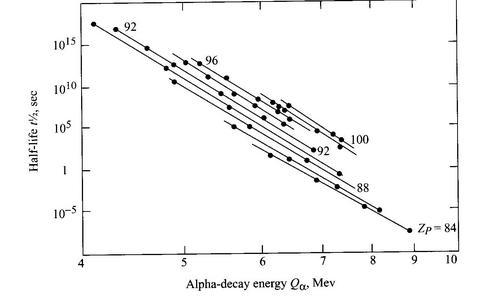 (click on image for larger view) Yes you can see how "jimmied" the lines are. The horizontal scale, by the way, is logarithmic, so that exponential (curved) functions show up as straight lines, standard practice in science. Sadly, for CTD, it looks like he is wrong again. Thanks. It's much better if people understand the nature of what they're looking at. False perceptions promote errors. The vertical scale appears to go up by powers of 10, I notice, and the highest mark on the scale is 1,000,000,000,000,000. Sorry, CTD, I thought you understood that this too is a logarithmic scale, a more obvious one than the other, because it has a 1 instead of a zero point. I grew up using a slide rule, so I know what logarithmic scales look like. It's just math, not science. Exponential functions plotted on log-log graphs will be straight lines. Enjoy.
|
|
|
|
|


