Thanks LindaLou,
Thanks again to RAZD for the science lesson.
Sorry that I can only brush the surface of what science says about radioactivity, as to delve much further requires some pretty intricate maths, the kind that makes eyes glaze over.
This article will give you an idea (unfortunately they use variables from previous definitions that are not defined, so it is hard to follow the formulas):
http://www.physics.queensu.ca/~phys490/Lecture/NucPart08_L15.pdf
Qα = Eb(Z, A) ? Eα(Z ? 2, A ? 4) ? Eα(2,4)
Now the we can translate the above condition for the possibility of an α-decay to Qα > 0. Fig. 14 shows a diagram with Qα-values for β-stable nuclei. Positive values start to appear for A
> 150.
While the energy range of alpha-decays observed in nature is relatively narrow (~ 2 – 12 MeV) the lifetimes span a range from 10 ns to more than 1019 years. To better understand this behaviour we will investigate the mechanism of this decay a little closer.
...
So we find for the decay constant:
λ = w(α)v<sub>α</sub>e<sup>-G</sup>/2R
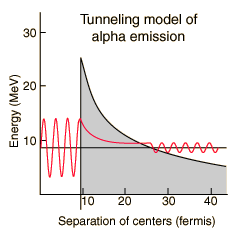
Perhaps LinearAQ can help with the maths. This picture may help:
The red line represents the energy level of the alpha particle, and the difference between inside and outside is the decay energy, Qα, while the decay shown is for the isotope in question. Long half life = little decay through the Coulomb Barrier = little difference in energy, so Qα is small, like 3 MeV for Bismuth 209 with a half-life of 10^19 years.
And because the decay while tunneling through the Coulomb Barrier is exponential, small variations in Qα are related to large variations in half-lives. Polonium 214 has a Qα of 7.69 MeV and a half-life of 0.000164 seconds.
So the fact remains that alpha decay energy and half-life are inter-related and you cannot change one without affecting the other.
So far, everything I have read shows that Polonium halos only exist in rocks that are infected with uranium inclusions and saturated in Radon, that they have been found in rocks of many different ages, that all such rocks also show Uranium halos, and that halos frequently overlap and follow visible fissures and cracks.
There is also this article
http://www.grisda.org/origins/15032.htmHalo identification is achieved through the measurement of the halo diameter. The size of the halo and the half-life of the isotope producing it are related. Assuming that the half-life of the parent isotope has remained constant throughout the formation of the halo, the initial energy of the alpha particles that produced the halos can be determined, and hence the parent radioactive isotope identified. In making this identification, Gentry assumes, as do other scientists, a constancy of radioactive decay rate for polonium. However, Gentry also wants to invoke periods of time that "... may have been accompanied by an increased, nonuniform radioactive decay rate" (p. 134). If there were periods of nonuniform decay rates, identification of any pleochroic halo from its ring diameter would be questionable at best! All available data indicate that halo ring diameter increases with increase in decay rate. Either the rates remain constant or they do not. Evidence from other sources (1) suggests that the decay rates have remained constant for all radioactive isotopes. Several problems arise when one attempts to invoke increased decay rates while at the same time keeping the halo diameters constant! Such inconsistency cannot be considered as a satisfactory argument.
Greater decay rate, shorter half-life, larger diameter halo. Change the decay rate, change the diameter.
Enjoy.
Note: my time is limited, so I only choose threads of particular interest to me and I cannot guarantee a reply to all responses (particularly if they do not discuss the issue/s), and I expect other people to do the same. Thank you for your consideration.