It's simple, CTD
There are lots of things that occur naturally. Spring showers haven't been observed finding their way to the center of the sun.
More likely, you mean to claim it suspended decay & accuse me of "arguing from incredulity" if I don't buy your story.
But folks, please consider carefully what these evolutionists are advocating! They imagine decay can be halted. If it can be halted for polonium, why not all other radioactive elements?
These same people openly assume decay rates are always constant, any time this assumption will help them produce evodates. Someone's story invalidates itself.
They also assume polonium has some desire to "find its way" to certain places and decay there. Sort of like the legend of the Elephants' Graveyard.
Some geologists must be fond of this concept, for wiki says
Note that even this is hypothetical.
What I note is that it has nothing to do with either the issue of Polonium halos or with Uranium Halos, it's just distraction.
Indeed, had polonium a motive, it still couldn't create the halos by the processes evolutionists describe. The problem with all migration scenarios is that the polonium must decay en route, unless there exists a means to prevent decay. If you know of such a means, I'd be interested to hear about it.
Not really: Radon is a gas and is capable of traveling within rock along the smallest paths known. When Radon decays into Polonium it is no longer a gas, and the rest of the decay pattern would be the same as for Polonium.
In addition, the decay from Radon to Polonium has almost exactly the same energy as one of the Polonium decay stages, and many times would produce a ring hard to distinquish from the later decay.
Here is an interesting paper by an amateur scientist that has looked at this issue:
Evolution's Tiny Violences: The Po-...ientist Examines Pegmatitic Biotite MicaThe suggested decay chain for Polonium is as follows. (I have begun the chain at Radon-222, fifth in the series of alpha particle- emitting daughters of Uranium-238, both for brevity and for another reason which will shortly become clear.)
86 Rn 222 (86 protons, Radon, mass 222) decays in about four days to Polonium-218 with the emission of an alpha particle of 5,486,000 electron volts (5.486 MeV). (Please note this energy value.)
84 Po 218 (84 protons, Polonium, mass 218) decays, through two additional non-alpha-emitting (beta decay) steps involving Lead and Bismuth, over a total of about 45 minutes, to Polonium-214 with the emission of a 6.111 MeV alpha particle.
84 Po 214 (84 protons, Polonium, mass 214, arriving via Lead-214 (27 minutes) and Bismuth 214 (20 minutes)) decays through two additional (and time-consuming) steps taking about 21 years, to Polonium 210, with the emission of a 7.687 MeV alpha particle. This involves the immediate alpha decay (.000164 seconds) of the Po-214 nucleus to Lead 210, which has a half-life of 21 years, then via beta decay to Bismuth 210 with a 5 day half-life, and another beta decay to Po 210. (There is a small chance of the Bismuth 210 appearing in its isomeric form, which has a half-life of three million years.) This Polonium-214 alpha energy is the highest in the Uranium 238 decay chain, and consequently creates the largest, outermost, halo.
84 Po 210 (84 protons, Polonium, mass 210) decays with a half-life of 138 days directly to Lead 206 (stable), emitting an alpha particle of 5,305,000 electron-volts' energy. (Note the close similarity between this energy and that of the decay from Radon 222 to Polonium 218.)
82 Pb 206 (82 protons, Lead, mass 206). End of the line. Stable Lead. No further decay is possible.
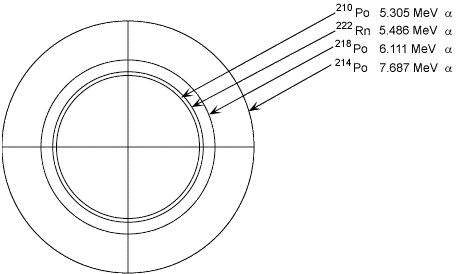
Figure 1. Polonium and Radon halos. Note the similarity in sizes of the Radon-222 and Polonium-210 halos.
At this point, one of those rare and welcome "Aha!" experiences occurred as I realized that Radon is:
* A gas,
* An inert gas,
* Produced a few atoms at a time in the U-238 decay chain, continuously and steadily over geologic time.
There was therefore no reason to think that Radon manufactured in any nearby Uranium mineral particle (uraninite, betafite, uranophane, etc.) would stay attached to the disintegrating particle; an atom with a filled outer shell would not 'attach' to the biotite crystal's atoms, nor would it be likely to remain attached to the disintegrating Uranium mineral inclusion. Moreover, with about four days to move around as single atoms subject to thermodynamic gas laws, it could wander literally anywhere in the mica permitted by the slightest crack, cavity, lattice discontinuity, or separation between crystal planes, "pushed" along by new Radon atoms forming back 'behind' it in the inclusion.
So once a path is developed, it would be followed by other radon gas atoms, and over time would create the halo.
He even talks about how to test this explanation - by seeing if you can find the double rings.
Interestingly this pattern is discussed in another paper,
Concentric rings of radioactive hal...a: a possible result of 238U chain decay, by Dipak C. Pal, Department of Geological Sciences, Jadavpur University, Kolkata 700 032, India:
Transmitted light microscopy of quartz-chlorite schist from Turamdih uranium deposit in Singhbhum Shear Zone has revealed the presence of distinctly circular aureoles of radiation damage, commonly referred to as radioactive halos or radiohalos, in chlorite surrounding inclusions of uraninite in the Turamdih uranium ore; particularly those surrounding tiny (< 2 mm) radiocentres show spectacular concentric aureoles. In well developed halos, four distinct rings of discoloration are clearly visible in host chlorite. The radiohalo pattern is in good agreement with the theoretical radiohalo pattern of 238U based on a-penetration ranges in air. Radii of individual rings surrounding tiny radiocentres (< 2 mm) in diametral/near-diametral sections are consistent and the mean radii of 32.4 mm (outermost), 22.0, 18.3 and 15.2 mm (innermost) compare well with the experimentally determined, theoretically calculated and observed penetration depths of a-particles emitted by 214Po (the outermost ring), 218Po, 210Po/222Rn, and 226Ra/234U/230Th (innermost ring) in biotite. Such ring structures can be assigned to the decay chain of 238U in which the above radioactive atoms correspond to daughters in the decay series and each of them emits a-particles of different energies. The undeformed circular nature of the radiohalos is indicative of their postkinematic origin. Petrographic studies also indicate possible mobilization of uranium by some later processes.
He starts with a generic discussion of halos and then moves on to the evidence for uranium halos, and concludes:
This study provides petrographic documentation of radiohalo patterns in chlorite caused by the decay chain of 238U. It has shown that the damage pattern and penetration depths of a-particles are similar to those found in biotite. To the best of the author’s knowledge, such studies are not available on natural chlorites, at least from India. The observational data presented here will add to the existing data and this study offers an opportunity for future research to characterize and understand the nature of radiation damages in sheet silicates in general and chlorite in particular, using modern techniques like laser- Raman spectroscopy, optical absorption micro-spectro- scopy, high-resolution transmission electron microscopy, etc. Preliminary investigation in this direction is currently underway. It is also interesting to note that although the rock is highly deformed, none of the radiohalos observed in the present study shows any signature of deformation of the host mineral. This is a clear indication of the postkinematic origin of the radiohalos. Trails of radiocentres with their characteristic radiohalos along foliation planes in tandem with the undeformed nature of the radiohalos are also possible indications of the post-kinematic origin for the radiocentres. Possible leaching of uranium by later processes may have important implications in U–Pb geochronological investigation.
So we establish that uranium halos do occur, with rings characteristic of uranium decay.
Again, this is a serious problem for anyone arguing for a young earth, as it takes hundreds of millions of years for them to form, due to the decay rate of uranium. You cannot say that Polonium halos are evidence but that Uranium halos are not: both need to be explained (if you are going to explain
all the data).
So? I never suggested it did. Why should I address this now? It's pretty trivial business to find the error. Those who desire to divert their attention to this bunk, well, that's their own business.
Yes, evidence that the earth is old must be ignored, must be called "bunk," must be discredited without actually looking at the evidence: that is the hall-marks of cognitive dissonance in operation.
Why should you address it: because it contradicts and invalidates your argument, and to ignore it is to ignore reality and the objective evidence of reality.
There's more. This article,
POLONIUM HALOS AND MYRMEKITE IN PEGMATITE AND GRANITE, by Lorence G. Collins, where he talks about some "Odd Circumstantial Facts":
When I looked closely into Gentry's Po halo studies, I noted four odd circumstantial facts contrary to his hypothesis. The first oddity is that his Po halos all occurred in granites and granite pegmatites, never in any other rock types, excepting locally near Bancroft.
In that area, the uranium-bearing calcite veins cross-cut the granitic rocks, and Po halos are absent from mafic rocks whether the mafic rocks are older or younger in age than the granites. This is true even when biotite is relatively abundant among the mafic minerals. These Po-halo-free rocks include biotite-bearing gabbros, diorites, and tonalites, as well as their volcanic equivalents. On the basis of field, chemical, and microscopic textural relationships, all of these mafic rocks are crystallized from magmas at high temperatures.
It is odd that Po halos are found only in certain, supposedly primordial, biotite-bearing granites and not in all primordial, biotite-bearing rocks. The Creator was evidently very selective about where he tucked the short-lived Po!
A second oddity I discovered was that all of the granites in which Gentry found Po halos also contain myrmekite. Myrmekite is a replacement mineral intergrowth, a fact that suggests that Po halos may not be present in all granites but only in granites formed by replacement processes. Conversely, perhaps only granites containing myrmekite should exhibit Po halos. In reality these do not always contain Po halos. Again, the Creator was very selective.
Some granites are derived from melted sedimentary or rhyolitic volcanic rocks, some by fractionation within magma (either partial melting or fractional crystallization), and some by partial melting and rising of magma that leaves behind a mafic residue (restite). Granites derived from melts do not contain Po halos.
The third oddity I noted is that Po-halo-bearing rocks are always associated with uranium concentrations. Gentry describes several uranium-rich localities that contain Po halos, including some in Finland, Sweden, Germany, Canada, and New England (Gentry 1988, page 36; Wiman 1930).
Why, one must wonder, would an all-powerful Creator choose to put Po halos only in rocks that contain abundant uranium? If Gentry is correct, and Po halos have no association with uranium, why does the Creator not put the Po halos also in granites free of uranium concentrations?
Polonium, being one of the daughter products of the radioactive decay of uranium, is expected to be found near uranium concentrations. To suppose a supernatural origin for the Po-halo-bearing granites is irrational.
A fourth oddity became apparent to me later as I delved into the detail of Gentry's hypothesis. Only selected Po halos, those for the isotopes 218Po, 214Po, and 210Po (products derived in 238U disintegration) have been found by Gentry (Dutch 1983; Gentry 1983). Potential Po isotopes of other mass numbers (215Po, 211Po, 216Po, and 212Po) are produced in the 235U and 232Th disintegration series (Fig. IV-8), but Po halos of these types are not found.
Why might the Creator not make Po halos of these other types, since all are available in nature? Does this unusual omission imply some simple natural cause for the selective presence of certain Po halos?
In other words, there is more to this story than just the existence of Polonium halos. He goes on to explain how normal physical and chemical processes can cause
That's twice you've shown that you're not paying attention. I recall that there is a good "young earth" argument associated with radiohalos, but we haven't been discussing it.
You haven't yet given a lick of evidence to support the assumption you claimed creationists were making, either. It was just more empty, hollow bunk. Spam away & let us see how many morons fall victim to your trickery. What's next? Apoloniogenesis?
That would be your argument from incredulity, strange how you predict your own behavior eh?
And meanwhile, the basic problem with the creationist argument is that if you have naturally forming modern Polonium, a modern source of Polonium, in such crystals, that then
there is no argument that they represent a young earth, only recent (new) Polonium. Whether stated implicitly or not, the argument only works if you exclude naturally forming modern Polonium from making the halos.
The evidence shows that there is an explanation for recent (new) polonium added to these rocks by natural processes.
The evidence also shows that uranium halos exist and are numerous -- evidence of the
fact that the earth is older than Polonium halos by hundreds of millions of years.
These same people openly assume decay rates are always constant, any time this assumption will help them produce evodates.
And if the decay rates did change, then the energy of the decay would change and the halos would be different: the uranium halos would be blurred over measurable distances instead of still found in the rings dictated by the energy of the decay in modern times.
Meanwhile, have you figured out where you were
proven wrong (by mathematics) on
half-life and your quarter life calculations?
Enjoy.


