Thanks CTD for basically admitting that there is no obstruction there to force the river to take this shape, by failing to provide any argument for an obstacle existing.
I shall not argue that any solid obstacle existed in that location prior to the formation of the Grand Canyon.
It is convenient, to say the least, that your story requires one. Thanks for choosing such excellent pics. They make it much easier for me to clarify things.
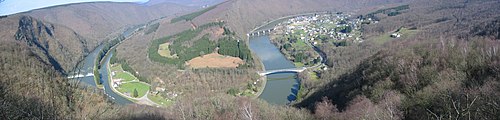
See that ridge the river's flowing around? That's an obstacle. Don't get distracted with the Meanderczar's claim that meanders don't form around obstacles - it's not the first time he's been wrong. Just look at the picture, and hopefully you won't have to try too hard to understand why this river's flowing on this course and doesn't have much chance of cutting the meander out any time soon, barring some big event.

Here, when we imagine the pre-canyon river, we have
no obstacle to keep the meander from being removed, either by a simple flood event, or just the gradual erosion that occurs when rivers flow. There isn't hide nor hair of any ridgeline - just flat, flat land. Yet for tenthousands of years, neither gradual erosion nor flooding removed this meander, according to RAZD's extra-special pleading.

Correct: at no time in all that past did the river flood over the banks and flow across the shortest route downhill.
The fact that this meander has not been cut into an oxbow does not mean that it is not a meander, just that it hasn't reached this final stage yet.
Instead the land began to rise before this occurred, and the river cut deeper and deeper as the land rose.
More trickery. RAZD needs a ridge to rise. If the whole area rises together, the relative elevations remain the same. The flatness remains. No obstacle is created. Why isn't the meander cut?
But if the rise is too rapid, the river can't flow uphill. And there's no part that can rise alone. Where could the rise occur that would preserve the meander and yet fail to result in uphill flow for this river? Look at the picture. Rise on the far side will let the water down into the bend, but not back out. Raising
any of the land in that picture without raising the rest is going to prevent the river from flowing at one point or another.
If any of this is hard to understand, please take another look at the pics and read what I said a little more slowly.
In fact you have said you do not want to discuss this issue. Curious how it keeps coming back as evidence that uplift occurred.
I never denied uplift. I've satisfied my own curiosity about the Grand Canyon, and it's rather boring reviewing what I already know. Were I convinced anyone cared, it'd be interesting to see how well I could teach what I've learned. So far, the evidence indicates nobody is interested in learning more about the Grand Canyon.
Rather than any obstacle, the actual topography looks like the land was fairly level and gently sloping from left to right -- the very conditions for formation of meanders in the river noted in the link\source. If there was an obstacle then where has it gone? Certainly it would not have eroded away it (a) it was an obstacle and (b) the top of the peninsula (where the obstacle to the flow would be) is still there.
Sure 'nuff! There's no obstacle, and there's nowhere to put one without stopping the river from flowing.
No obstacle = no reason the meander should remain. 300 years would be stretching it. Evotime is totally out of the question, if floods or normal river erosion cut off meanders.
Saying that there is a logical fallacy in an argument doesn't make it so - you have to show the actual fallacy exists, and to claim there is a fallacy when none exists is a falsehood.
Claiming no floods occured; claiming normal everyday erosion didn't take place - both are special pleading, and folks can look it up. I just got done providing links what? Was it a week ago?
Catch that Linear? That's twice RAZD's story differs from his own source.
Not only does the source go on to talk about incised meanders (so there is no contradiction) but it is a logical fallacy to claim that because something has not happened that it won't.
Incised meanders occur where there are hills, ridges, stuff like that there. But who wouldn't guess the Meanderczar'd be claiming a meander's "incised" where the land is just plain flat, if it's convenient.
RAZD shouldn't have provided those pics. I feel like my words are all just redundant.
Nope, just more evidence that long term geology, standard river erosion and uplift provide all the explanations for what is seen in the Grand Canyon. Evidence that similar incised river erosion patterns exist in other places in the world that are also associated with uplift.
I kinda like that vague "associated with uplift". Your France pic showed what kind of uplift would preserve a meander, and your other pic shows that this isn't going to save your bacon. Got any more evidence like that?


