Thanks for the input Russell2.
One definition of evolution which I gave was the change in allele frequencies from one generation to the next which is another way of saying pretty much what you said in point 1 so I think we agree on that.
Yes that is a common definition. I prefer hereditary traits, as alleles are difficult to apply to fossils, while traits can be seen in the bones (the effects of the alleles). I also tend to be more of a naturalist than a genetics type, and prefer visible traits for field observations.
Point two I think you need to explain better, CTD is right to complain about this one though he overplays it I would suggest as you are certainly on the right track.
Speciation is difficult to define, for living and fossil organisms, agreed. I've also seen the terms "arbitrary speciation" and "non-arbitrary speciation" applied to fossils, where the first is just an arbitrary collection of accumulated changes since the type fossil of the ancestor was discovered. When you have a long lineage that shows change over time, choosing where to break these into different species categories is arbitrary.
Non-arbitrary is when you have a clear division of the population into two or more daughter populations. Pelycodus is provides an example of both of these types of speciation typical in the fossil record:
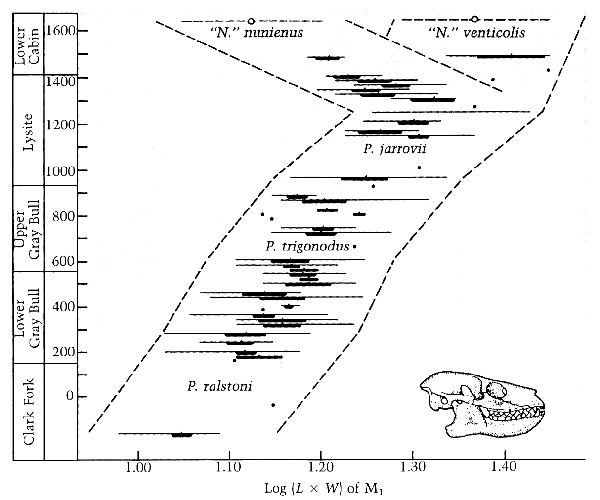
Here you see a couple of "arbitrary speciation" events at the bottom and then a "non-arbitrary speciation" division at the top.
These are simply examples of species which have not totally separated though they are clearly on the path to do so unless something dramatic changes to force them back together.
The key is that diversity has begun the moment that two populations cease to share genes. If they later coalesce back into a common population then this just adds some new variations to the mix.
Micro and Macro evolution are very vague terms with no specific fixed meaning. I personally try to avoid using them preferring to explain what has changed without the labels. It makes for less confusion.
I agree. I've tried on other forums to have creationists there explain what they think "macroevolution" is, but have not had any real luck in that endeavor, no matter that it appears to be a central element of creationist claims.
Conclusion (4): I don’t agree with point four. ...
Acquired traits
Oops I see I had an error there, it should have read:
Conclusion (4): hereditary traits, environmental traits, and learned traits, that don't affect survival or breeding can still spread within breeding populations.
Sorry about that and any confusion caused.
The point here was that each of the different forms of traits that can be inherited can be neutral and still be spread in the population as long as the conditions for the traits inheritance are maintained.
Genetic maintained by inheriting DNA
environmental maintained by inheriting the environment
learned maintained by inheriting the learning
And yes, this also includes any traits that are mildly detrimental in that they don't completely inhibit the survival and breeding of the organisms affected.
Conclusion (3): I’d suggest that this is a controversial point. Meme’s may well be passed on due to their ability to be passed on rather than on their utility.
So they may hitchhike as well as be either +/-/neutral?
Conclusion (5): I agree. Such divergent populations constitute insipient speciation events. Several such have been observed in the wild and in lab tests in great detail even to the point of full speciation. Fascinating research indeed!
It seems that mate recognition behavior is often the key to me, thus the lack of breeding at the cross-over of ring species, while we can create artificial insemination hybrids of camels and llamas. Later diversification mutations may make it impossible to mate (different shape genitalia in daughter species of mosquitos), but it began with different behavior, perhaps as a response to different ecologies.
Enjoy.


