
CAUTION: CONTAINS GRAPHIC PHOTOS BELOW!
Facts about Late Term Abortion
* Late term abortions are legal in most states. “Late Term” means that an abortion can be done up to the moment of birth. This means that a birth is being induced and in the act of birth the baby is being killed.
* Some late term abortions are being done by putting a salt-acid mixture into the baby’s lungs so that the child suffocates.
* In case of a failed late term abortions, means that if the child is BORN ALIVE, the “doctor” will often kill the crying (LIVING) baby. The act of killing is often been done by drowning the struggling child in a bowl of water. Sometimes the baby will be just strangled to death or it’s head is being cut off.
* The remains of the child will be thrown in the trash or the corps will be used for medical testings.
* INFANTICIDE – The following issues have been raised in order to get you to think more critically about infanticide and why infanticide would be an acceptable form of family planning among the majority of pre-industrial societies. It is normal for people in one society to judge the behavior of people in other societies in terms of the moral values of their own society. This is, in fact, the very definition of ethnocentrism. However, many issues can be raised regarding a variety of methods of family planning that place the practice of infanticide within a broader anthropological perspective.
* Most Americans would consider infanticide to be morally wrong. However, infanticide is widely practiced throughout the world. Is infanticide necessarily immoral and, if so, is it universally wrong? By what criteria do we make that determination, and do those criteria distinguish unambiguously between abortion, which is legal in our society, and infanticide which is not, but which is accepted and practiced in other societies?
* Abortion is legal and is accepted by the majority of the American population as morally correct. Why is abortion an acceptable method of family planning in the U.S., but not infanticide? To what extent are we, by accepting abortion and rejecting infanticide, defining one method of terminating a human life as morally acceptable while condemning another form as morally unacceptable? If infanticide is practiced by peoples who do not have access to abortion technology, can they be considered morally wrong for terminating a human life by the best means they have available to them while accepting our method of terminating a life because we possess the technological means to end that life before birth?
* How does the fact that our own society’s stand on both the legality and morality of abortion has changed radically in the past 30 years affect our certainty regarding the immorality of infanticide? Isn’t it quite possible that future generations may come to accept infanticide as a reasonable method of family planning, just as we now accept abortion and increasingly accept euthanasia and doctor-assisted suicide –practices which would have resulted in a doctor’s losing his or her license to practice medicine a mere 10 years ago?
* Steven Pinker, in his article, “Why They Kill Their Newborns”, distinguishes between neonaticide and the killing of older children (filicide). He shows that, while our own society condemns infanticide, we are, in fact, quite tolerant of those who kill newly born children. He reports that of nearly 300 women charged with neonaticide in the U.S., not one spent more than a night in jail. The general population was much more willing to deal leniently, for example, with the Grossberg-Peterson case involving the killing of a newborn than they were with the case of Susan Smith, who killed her two sons: one 14 months old, and the other 3 year old.
* Our notion that infanticide is committed by disturbed individuals is also not supported by research. First of all, women who practice neonaticide generally go on to become loving supportive mothers when they do have and raise children (as do mothers who have had abortions), in contrast to those women who kill older children. Secondly, as Pinker states, “it’s hard to maintain that neonaticide is an illness when we learn that it has been practiced and accepted in most cultures throughout history.” That many societies practice infanticide is clearly illustrated by the articles in the Infanticide packet.
* The acceptance of abortion but not infanticide in the U.S. has been justified on the grounds that a baby is alive while a fetus is not. When does a human life begin? How do we define life? In the article referred to above, Steven Pinker discusses how difficult it is to determine when a human organism becomes a person with a right to life. Conception, birth, the end of the second trimester are all rather arbitrary definition points for when a human organism becomes a person. Viability is also problematic, given that the human infant cannot survive on its own for several years after its birth and that many infants cannot survive at all without medical intervention, to say nothing of large numbers of the elderly. Furthermore, infant viability is a matter of degree and is clearly much less developed in humans than in most other mammals. Given the difficulty of establishing clear objective criteria for when personhood is achieved –in some societies “personhood” is not conferred until well after birth– on what grounds do we claim that one point in the human organism’s development is more valid and objective (i.e., less arbitrary) for establishing “personhood” and, thus, a right to life than any other point? If the definition of “personhood” is largely socially determined, to what extent is the criteria used for defining “personhood” in our own society any more objective and valid than that used in other societies? How does the controversy over when an abortion is acceptably performed in the U.S. affect our understanding of the social basis of our society’s definition of when life begins? What factors determine who is likely to accept Pinker’s definition and who is likely to reject it? How does their stand on the issue reflect their personal interests rather than an objective scientific look at the issue? Furthermore, when we set arbitrary boundaries as our defining points for the beginning of life, to what extent do we inadvertently kill human organisms that develop more quickly than the established norm? Finally, why is “personhood” used to determine when a human organism is alive rather than some less subjective critria? If we don’t use “doghood” or “cathood” to determine when dogs and cats are alive, are we being logically inconsistent to use “personhood” to determine when humans are alive? Is there a uniform, objective biological definition for the beginning of life that can be applied systematically to all living organisms, including dogs, cats and humans?
* Most biology textbooks define life as possessing the following characteristics: Cells, energy, heredity, reproduction and responsiveness to the environment. All living things are composed of cells. Even such microscopic unicellular organisms as bacteria are considered alive. All living things also acquire and use energy to maintain metabolism. All living organisms also possess DNA organized into genes and chromosomes which form the blueprint for how that organism will develop and grow. Similarly, all living organisms are potentially capable of reproduction. Being able to reproduce offspring which share their genetic material, living organisms (unlike non-living matter) are able to cause the transfer of genetic information from one generation to the next. Finally, living organisms are responsive to their environments. That is, they are affected by their environments and attempt to adapt to those environments. Are these characteristics, which are presented as distinguishing living organisms in nearly every biology textbook written, less applicable to a fetus than to a baby or a young child, to an invalid or an octogenarian, or for that matter to any human being? (Would they also apply to both the sperm and the unfertilized egg? The Roman Catholic Church maintains that they do, which is why it opposed artificial birth control.) If so, then on what logical or scientific grounds is it determined that a baby or a child is alive but not a fetus? What does this say about our society’s support of abortion but not infanticide? Is it logically consistent? And if it is not, then why is it so widely accepted?
The definition of when life begins has changed radically in the U.S. during the past 40 years. To what extent has the definition of when life begins changed because newer definitions serve the changing interests of the individuals or political groups doing the defining? To what extent is the changing definition of life and the recourse to such concepts as “personhood” a function of the pivotal role that the abortion issue plays in American politics? Proponents of abortion in the U.S. refer to abortion as a “right” and challenge any qualification on a woman’s “right to choose”. Any factor that threatens that “right” is vigorously opposed, including mandatory waiting periods and parental notification laws. To what extent might the application of an objective interspecies definition of life to humans in general and to fetuses in particular, also be perceived as a threat by those who want to promote abortion as their “right”? A recent article in The Economist titled “The War That Never Ends” (June 13, 2003) examined the abortion issue in the U.S. at the 25th anniversary of Roe vs. Wade. The article distinguished between the continuing controversy over abortion in the U.S. and its general acceptance in Europe, including in such predominantly Roman Catholic countries as France, Spain and Italy. The article viewed the problem this way.
The shocking truth about Late Term Abortions. This is what abortion “doctors” don’t tell you: A birth is induced, the struggling, crying baby is being ripped from the womb feet first, then a big needle is crushed into the baby’s skull from behind and the brain is being sucked out. The baby will be born dead. The American Holocaust is very well alive!
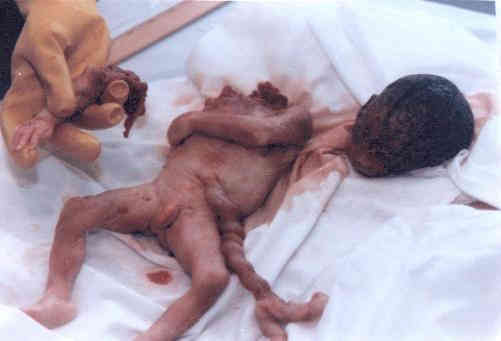
The battered and ripped apart corpse of an American Citizen. His rights violated, murdered and kicked in the trash. This dead child was found behind an Abortion Mill in St. Paul in 2002. Killed and put in the trash, it’s body still warm. This is what Barrack Obama stands for.
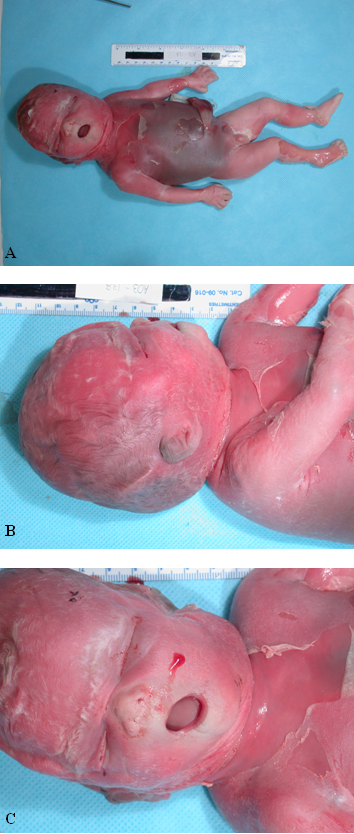
This could have been your brother, your son or your friend. He was killed by heartless liberals that don’t value life. He could have invented a cure for cancer or he could have composed a beautiful symphony. He is one of the 50 Million killed in the American Holocaust.
I am so very very sorry Lord.
Please forgive us.